I am an environmental anthropologist who is interested in belonging, kinship, islands, more-than-human ethnography, political ecology and, historical ethnography.
My research to date has focused on Lord Howe Island, Australia. Lord Howe Island is a place of outstanding natural beauty, immense terrestrial and marine biodiversity, rare endemic species and, as a result, intensive scientific and environmental conservation attention. First discovered by humans in 1788, Lord Howe is also home to a community of about four-hundred residents who claim various forms of belonging to the Island – claims which are arranged primarily through ideas of intergenerational kinship. My research explores contestations over conservation on the Island that arise, I argue, as belonging is negotiated.
My research and writing is led by an ethic of immersive ethnographic fieldwork, a deep interest in historical ethnography, and a commitment to creating relevant, applicable research that is accessible to audiences beyond academia. I have been engaged by the Lord Howe Island Board and the Lord Howe Island Marine Park Authority to provide applied insights from my anthropological and archival research to assist in the management of Lord Howe Island.
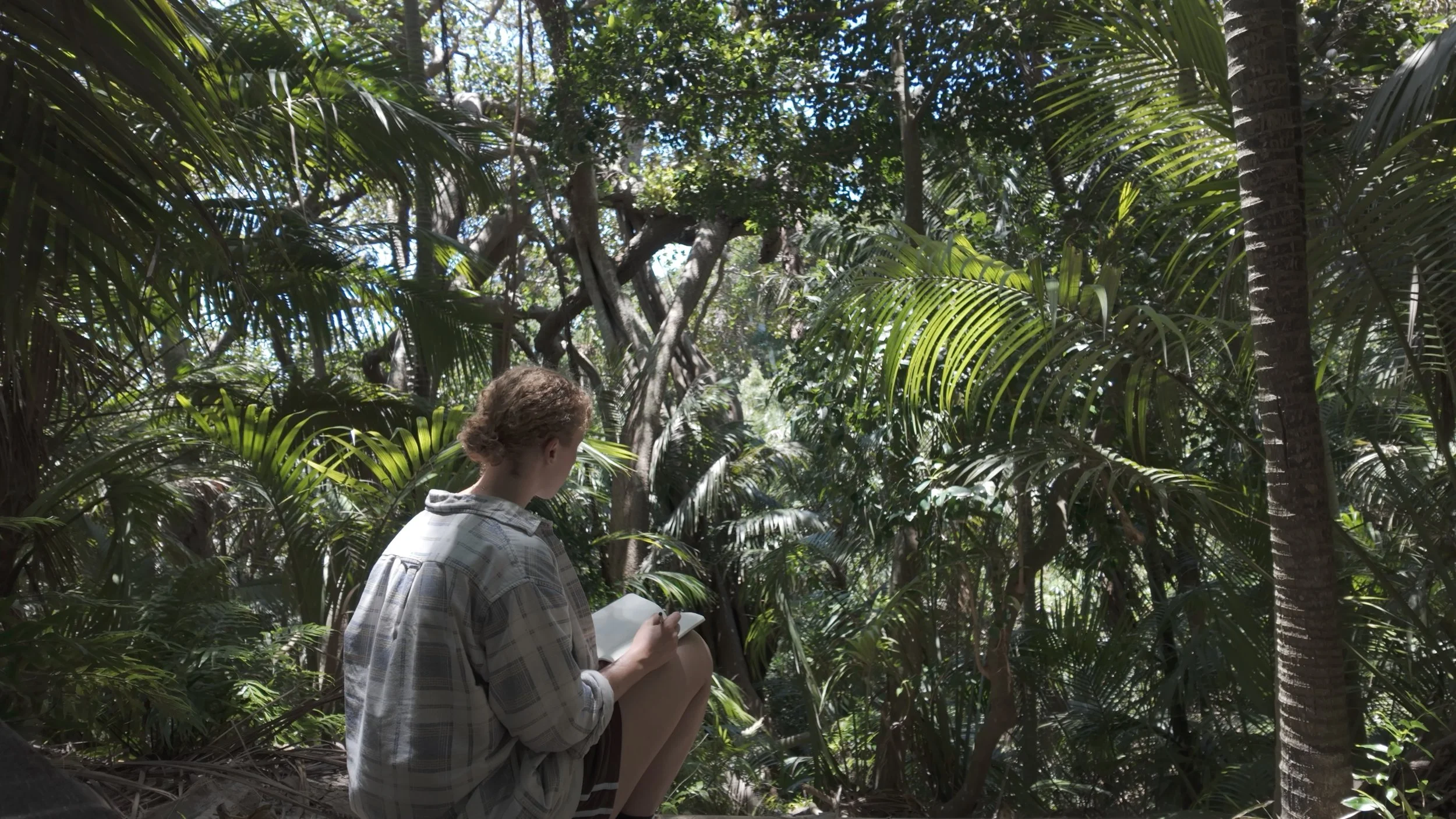
My research is also informed by a passion for visual anthropology. I experiment with creative forms of representation and research, particularly through artwork created during fieldwork, produced in attempts to practice the ‘art of noticing’ (Tsing 2015). The processes of creating such artworks are key to my practice of more-than-human ethnography. See my ‘Art’ page for more.
My PhD thesis, ‘Tides of Change’: The Political Ecology of Belonging and Conservation on Lord Howe Island was completed in 2025. It is available here https://doi.org/10.17863/CAM.122578.
Research Interest:
More-than-Human Ethnography, Applied Anthropology, Conservation, Political Ecology, Kinship, Belonging, Eradication, Bureaucracy, Science, Historical Ethnography and Visual Anthropology.